
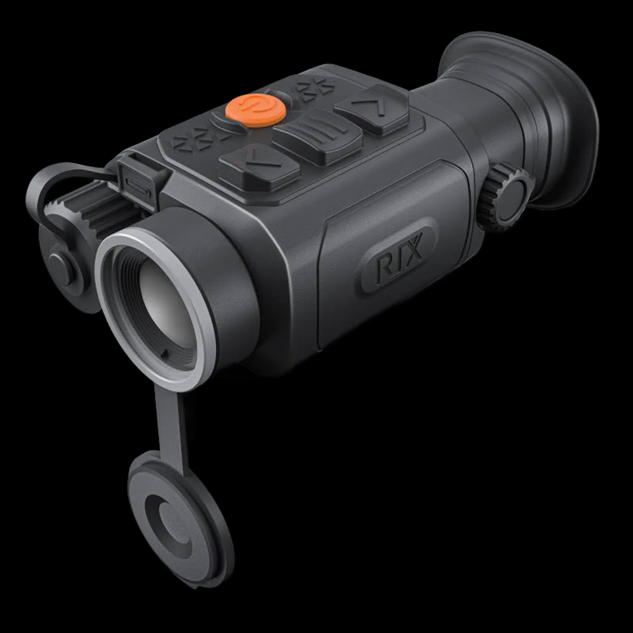
There may be occasions in the field wherein you will be best served by a thermal scope, and there are occasions when a supporting optic like a thermal monocular will suit you best.
The best brands out there offer both options, and some are multi-functional devices that can be run as either. In this case, we will be focusing on two thermal monoculars, the RIX ST3 Stride Lite and ST6 Lite.
In the event you were looking for a RIX thermal scope but you’ve determined what you really need is a handheld optic for scouting, scanning and tracking, one of these two options might serve you better.
Here’s what you should know about each of them.
The RIX Stride ST3 Lite
The RIX Stride ST3 Lite is a handheld thermal monocular with a 384x288 thermal sensor with a 12μm pixel pitch and a NETD rating of 20mK.
It has a 15mm, F1.0 lens, is capable of 1-6x magnification, and has a detection range of 852 yards.
Though they sport the same dimensions, the RIX Stride ST3 Lite is a little bit lighter than the ST6 Lite, which makes it the preferred option if you are really looking for a lightweight thermal monocular, since it weighs only .42 lbs; ultimately, though, the difference should be considered negligible.
The RIX Stride ST6 Lite
Now let’s take a closer look at the RIX Stride ST6 Lite, which is the more powerful of the two RIX thermal monoculars in this series.
This thermal monocular has a 640x512 thermal sensor which also has a 12μm pixel pitch and a NETD rating of 20mK.
It has a 25mm F1.0 lens capable of 1-6x magnification, but a slightly longer detection range, at 1423 yards.
It is also ever so slightly heavier than the RIX Stride ST3 Lite, and weighs .45 lbs.
One of the main differences between these two, however, is that the Stride ST6 Lite offers an adjustable focus, which increases clarity in most situations and makes the monocular more versatile overall.
What Both of These RIX Thermal Monoculars Offer
All in all, there is still a lot of common ground between these two RIX Thermal monoculars.
Both sport the same dimensions and profile, at 4.7x2.8x1.9 inches, making them fairly compact, and excellent as lightweight, handheld thermal monoculars ideal for fulfilling a supporting role in the field.
Both are also built tough, and sportsman IP67 rating against moisture and particulate ingress, making them ideal for use in the field, as they will resist the elements admirably. They also deliver an operating temperature range of -4℉ to 122℉.
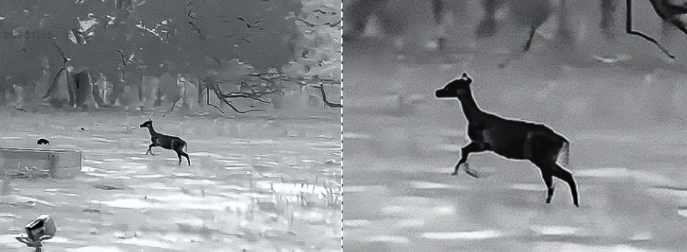
As for the display, both offer a 1024x786 OLED display which is capable of presenting the sight picture in 6 different color palettes, including red hot, white hot, black hot, and red and green monochrome as well as color.
Some of these, especially the red monochrome and green monochrome, are ideal for use at night as well as in low-light conditions as these color palettes help preserve your night vision so you can avoid temporary blindness in the field at night.
Both of these RIX thermal monoculars are powered by common, 18650-style rechargeable batteries, increasing convenience and reliability. Under ideal conditions these monoculars can enjoy a battery life of up to 4 hours.
These thermal monoculars also both offer the built-in functionality of onboard photo and video recording, and are equipped with 32gb of storage for .mp4 and .jpg files, adding to their convenience, versatility and functionality.
Another one of the great things about these thermal monoculars is that they are versatile and offer multiple different mounting options, including as helmet-mounted thermal optics. In order to preserve their functionality when used in that capacity, the buttons are located on the bottom of the device.
Which Should You Get?
Ultimately, both of these RIX thermal monoculars can be an excellent choice if you need the versatility and support of a monocular.
If you’re looking for a lighter, more affordable option and aren’t fazed by the fixed focus of the Stride ST3 Lite, then that is likely the best option for you.
On the other hand, if clarity is critical to you, and the adjustable focus is appealing, then the slightly higher price and weight of the Stride ST6 Lite constitute the better option. In that case, this is the one you should get.
Either way, both are compact and highly versatile thermal optics that make a suitable alternative to RIX thermal scopes if you don’t need a dedicated scope for your rifle and need something better suited for scanning or scouting.
Is a RIX Thermal Scope for You Instead?
If the question is not one of which thermal monocular is the better choice for you, but whether or not you would be better served by a RIX thermal scope instead, ask yourself some of the following questions:
- Do you need a thermal optic mounted to your rifle for the purpose of executing a shot?
- Do you need an optic that’s capable of ballistic calculation?
- Would you prefer a multipurpose thermal optic that can be run as both a scope and a monocular?
If the answer to any of these questions is “yes” then you should consider a dedicated scope with a reticle and ballistic calculation functionality, as the thermal monoculars that are the focus of this article don’t offer those levels of functionality.
Questions About These RIX Thermal Optics?
Want to learn more about either the Stride ST3 Lite or ST6 Lite, or about any of the RIX thermal scopes we sell here at Dark Night Outdoors?
You can learn more on our website, but don’t hesitate to reach out to us directly at 309-781-8421 and we will answer any questions you have or even make personalized recommendations if you’re not sure which thermal optics are best suited to your unique use case.
