



Free shipping on orders over $399* · $7.99 flat rate below $399*
Call today for current thermal scope specials and the latest pricing
Returns, Shipping & Preorders
Login / Sign Up

LUMI H35R Thermal Monocular 2.5X 640 35mm LRF
Watch the video Specs Overview
DNO PRICE:
$2,399.00
For a Limited Time
$2,099.00
 Free shipping on orders over $399*
- No sales tax outside Illinois
 No card fees and 2% off when you pay by e-check
 Hunters on the phone to help you choose
Goes with this Nocpix


Overview
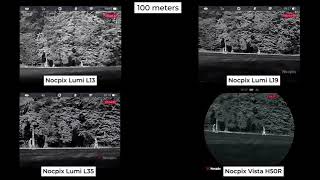
LUMI brings the power of thermal observation devices to a compact and user-friendly form-factor for hunters on-the-go. The LUMI series of handheld thermal monoculars features a high quality thermal sensor, available in 384x288 (L models) or 640x512 (H models) paired with a 1024x768 AMOLED display. Available models offer either a 2.5x base magnification (H models) for a wider field of view, or a 4x base magnification (L models) for identifying targets at greater distances.
From our initial launch last year, customers loved the compact and convenient form-factor of the LUMI L35 and H35. Customers also loved the laser rangefinding capability of the ACE and VISTA models. We sought a way to combine these ideas — introduce a laser rangefinder system to the LUMI platform without increasing the physical size of the unit or adding complexity of the design. This year, we’re excited to introduce the LUMI LRF. With a new 875-yard rangefinder (+/- 1-yard accuracy), this model still uses IRB-2 (18650 style) batteries, has a 1024×768 AMOLED display, and all of the other features of the original LUMI series.
- Now available with an integrated 875-yard laser rangefinder.
- Lightweight and compact design easily fits in a pocket or the included MOLLE-compatible pouch.
- Weatherproof rubberized texture increases durability and is not cold to the touch.
- Powered by a common 18650 style rech
- argeable battery with a spare battery included.
- Advanced R+ image processing provides enhanced image quality during digital zoom.
- Onboard photo, video, and audio recording.
Key Product Specifications
Sensor: Nocpix 640 (640×512) 50 Hz
Objective Lens: 35 mm F/0.9
NETD: ≤18 mK
Magnification: Native/Optical: 2.5X, Digital: 4X
Data Sheet: LUMI H35R Data Sheet
Product Manual: LUMI LRF Series Manual
Device Technology: Thermal Imaging
Pixel Size: 12 μm
Display Resolution: AMOLED 1024×768
Detection Range: 1,750 Yards
Color Palettes: White Hot, Black Hot, Red Hot, Color, Violet, Crimson, Viridian
Rangefinder: Integrated 875 yard LRF
Specs
- Brand
- Nocpix
- SKU:
- LUMI-H35R
- UPC:
- 850048751637
Videos
Videos Hide Videos Show Videos

Frequently Asked Questions
Is the Nocpix LUMI H35R a good thermal?
For a pocket-size scanner, it covers what most hunters need: a 640x512 sensor, ≤18 mK sensitivity, 1,750-yard detection and an 875-yard rangefinder. It runs on a common 18650 style battery and comes with a spare, so a cold night doesn't end your hunt early.
Are thermal monoculars worth it?
If you hunt at night, yes. Scanning with a handheld monocular means you aren't sweeping the field with your rifle, and you can spot game before you set up. A ranging unit like the LUMI H35R also tells you the distance, so you know whether the shot is in range.
Can you use a thermal monocular while deer hunting?
In most states you can use one to scout or recover a deer, though rules on carrying it while hunting, or using it at night, vary. Check your state's regulations. A small unit like the LUMI H35R is handy for finding a downed deer after dark, since the body stays warm for a while.
What's the best magnification for a monocular?
It depends on your ground. Lower base magnification gives a wider view for scanning close and medium range, while higher magnification helps identify animals far out. The LUMI H35R uses 2.5x for a wide field; the LUMI L models step up to 4x with a 384 sensor.
Other Nocpix models in
