








Currently, Nocpix manufactures two distinct categories of thermal optics: weapon sights and handheld viewers (often referred to as scanners).
After speaking with many of our dealers and end customers, we have learned that most American buyers—especially predator hunters—tend to purchase a thermal weapon sight before investing in a thermal monocular. In Europe, however, thermal monocular sales match or even exceed those of rifles, and the "rifle optic first" trend is far less pronounced. While there are many possible reasons for this, three likely factors stand out:
- The end user is already a predator hunter using a light and a daylight optic or a digital night vision scope. They turn to thermal technology to upgrade their weapon sight.
- Compared to Europe, rifles in the U.S. are more accessible. There are generally no waiting periods or limits on the number of rifles one can own, removing barriers to the next rifle build—aside from financial constraints.
- Hunters tend to be results-driven, focused on the tools that lead to success. Most of us vividly remember purchasing our first rifle or scope, but how many recall buying their first pair of hunting boots? Despite spending far more time in the boots than behind the scope, the latter is associated with success, making it the more memorable and exciting purchase.
Through additional conversations with dealers and hunters, I’ve learned that it’s not uncommon for a hunter to purchase a thermal rifle scope first, only to return the following week to buy a thermal scanner. This makes sense—after just a couple of night hunts, it becomes clear that scanning with a handheld unit is far more comfortable than constantly raising a rifle optic. Additionally, there's a critical safety aspect: hunters need to observe their surroundings without pointing a rifle at every movement. This parallels big game hunters carrying binoculars—since they spend much more time looking than shooting, they need a comfortable and safe way to do so.
While many night hunters will eventually own both a handheld scanner and a rifle sight, there’s an argument to be made for doing it the other way around: using a thermal scanner to locate predators or hogs, then deploying a weapon light for the shot. This approach minimizes unnecessary light usage, reducing the risk of spooking animals before "go time."
For hunters on a budget, there are also hybrid optics that serve as both a handheld scanner and a weapon sight. Some models can even function as a thermal clip-on, a monocular, or a helmet-mounted unit. These compact optics offer versatility, but since they must accommodate multiple roles, they typically feature 1x magnification—less than what hunters usually prefer in both weapon sights and scanners.
If you’re considering a "combo" unit, ensure it starts with a weapon sight that is actually recoil-rated. Many have tried various ways to mount a handheld optic to a gun—after all, what’s more American than attaching cutting-edge tech to a rifle? But handheld thermal optics and dedicated weapon sights are built differently. It’s not just about whether the unit has a reticle; the construction matters. Most handhelds prioritize ergonomics and lightweight materials for comfort during extended use. Weapon sights, on the other hand, must endure recoil, often requiring a metal body or frame, a solidly mounted sensor and lens, and a robust metal mount that won’t shift under recoil. All Nocpix thermal optics are rated to withstand the recoil of a .300 Winchester Magnum or 7mm Remington Magnum. How is that calculated? That’s another article entirely—stay tuned.
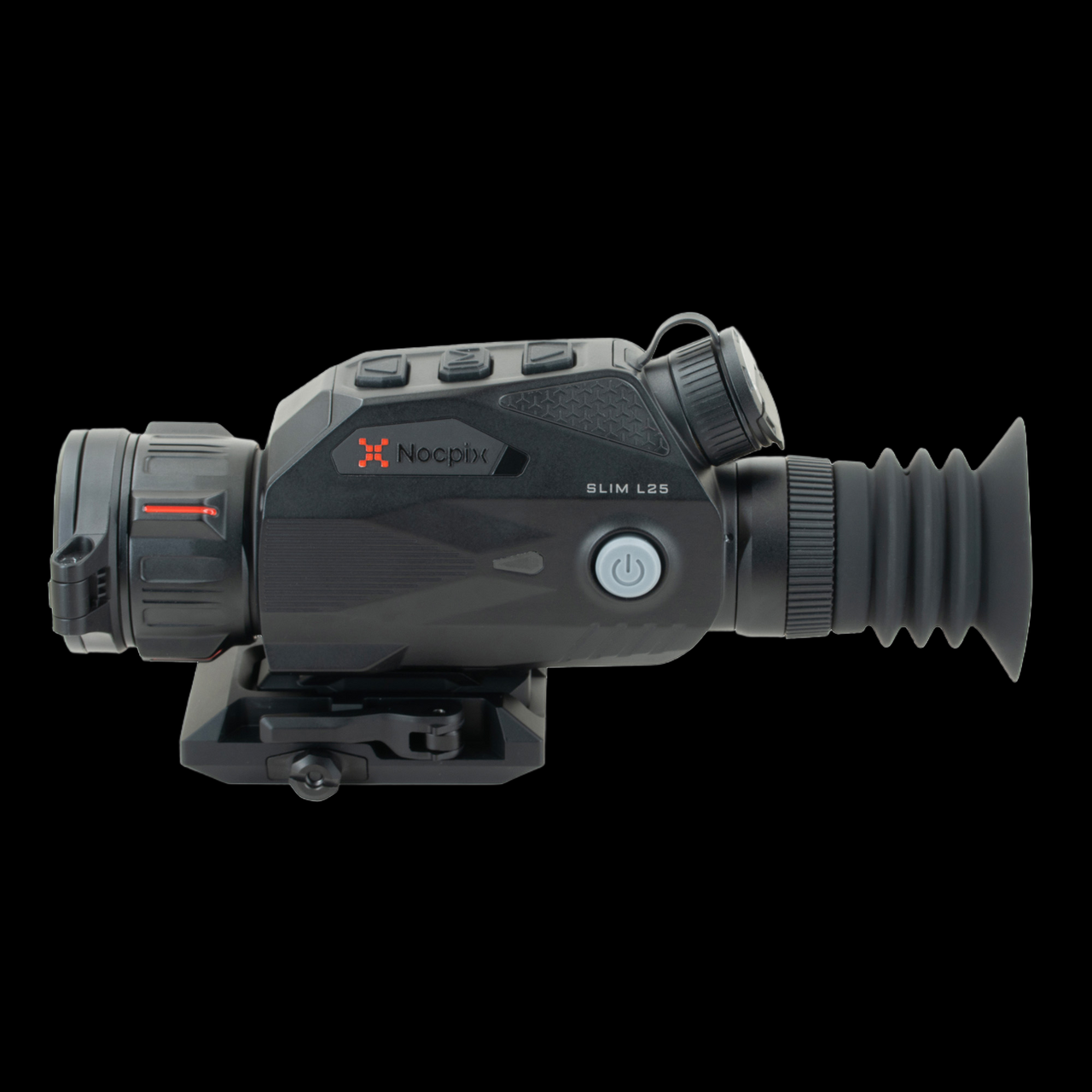
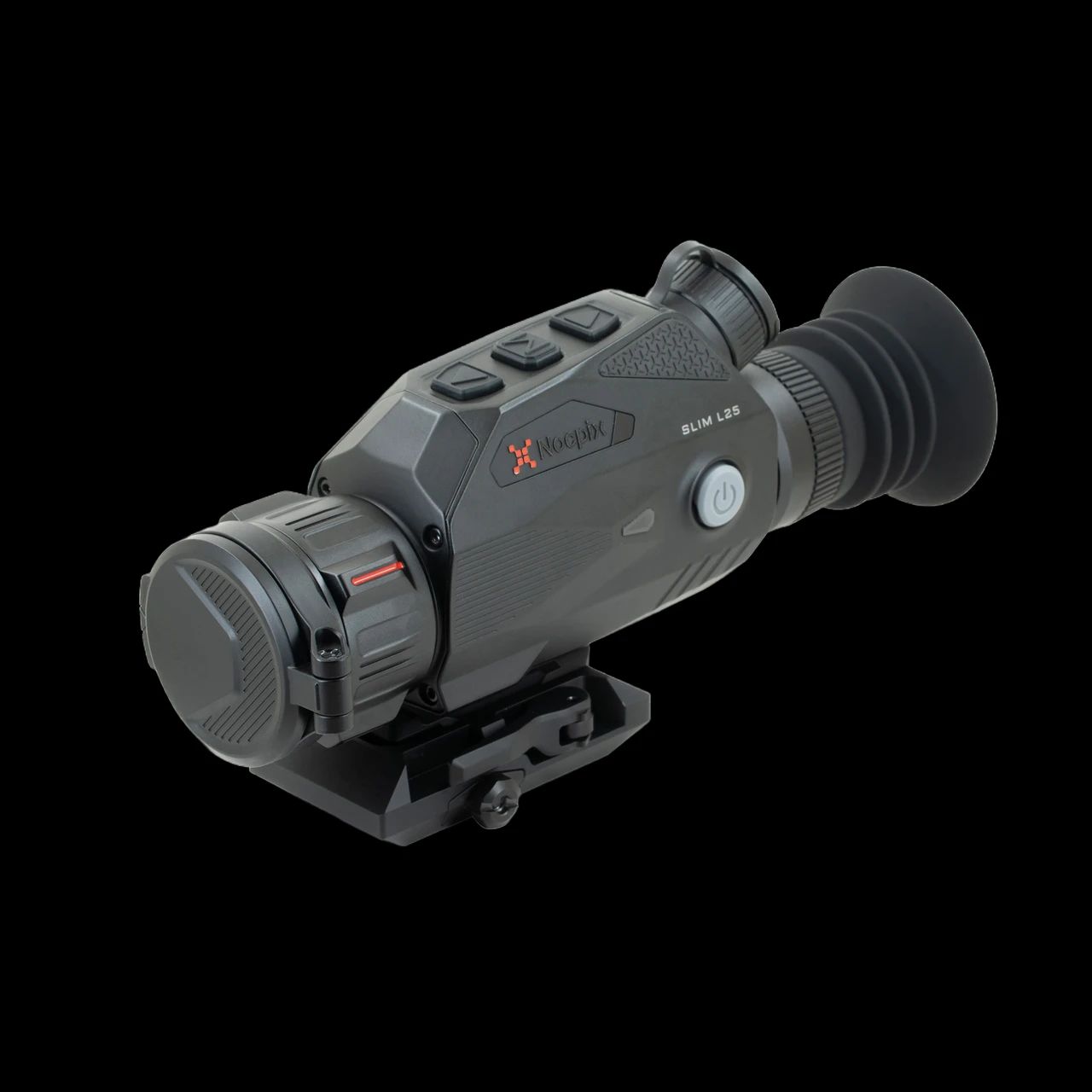
This discussion brings us to the Nocpix SLIM, designed to answer the question: "What if one device could function as both an effective handheld scanner and a practical rifle sight without breaking the bank?" The unit’s name hints at its design—its slim, vertical form with three top-mounted control buttons is naturally ambidextrous and fits comfortably in hand.

One of the SLIM’s most crucial features is its mounting system. An aluminum "foot" extends from the sight’s underside, fitting into a machined "shoe" that remains on the rifle’s Picatinny rail. Both components are precision-machined from aluminum and feature magnetic inserts—not to hold the optic in place, but to provide an index point for quick, precise alignment. Since our customers are night hunters, this system is designed for ease of use in the dark. A strong clamp and locking lever secure the optic firmly.
Why the extra design work? Haven’t QD Picatinny mounts been around for a long time? Yes, but traditional QD systems are built for flexible placement anywhere on a rail. Our goal is different: to ensure the optic returns precisely to the same position as quickly as possible. T-marked rails were the military’s solution for modular rifle builds, where each slot has a number so operators can note accessory placement. While effective, this system requires reading numbers—not ideal in the dark or for rapid deployment.

The next logical question is, "Does it return to zero?" The good news is that return-to-zero is measurable, not just a yes-or-no claim. The SLIM’s mount is guaranteed to return to zero within one minute of angle (MOA). This standard is upheld by other reputable brands like American Defense Manufacturing, Bobro, Burris, and Badger. Some mounts exceed this standard, but 1-MOA is a safe and reliable benchmark for night hunting applications. (Recoil did a full study on QD mounts if you really want to dig in.)
At a recent range day event in Colorado, I demonstrated this feature with the SLIM. Users detached the optic to scan the area, spotting hot suppressors, warm brass, and cold noses in the winter air before reattaching it to the rifle. Many remarked on how quick and intuitive the process was. The SLIM H35 (the 640×512 variant with 2X base magnification) was mounted on a 16-inch Stag Arms AR-15 chambered in .223 Wylde, paired with a Banish silencer and a carbon fiber tripod using an Arca-Swiss rail and ball head. Over 600 rounds were fired throughout the day, and the optic was removed and reattached 40 to 50 times. Despite the intense use, I took the final shots with a scorching-hot rifle and still had no trouble hitting a 6-inch steel target at 100 yards. While not a precise MOA test, this real-world stress test demonstrated the mount’s durability and reliability.

For a more controlled evaluation, the Nocpix USA product manager used match-grade ammunition to shoot a 1-inch group with the SLIM, then removed and reattached the optic before firing another 1-inch group. The result? Minimal to no point-of-impact shift.
If you’re looking for both a thermal handheld monocular and a thermal weapon sight, the SLIM deserves serious consideration—especially if you’re on a budget. At $2,000 for the 384-resolution model and $3,000 for the 640-resolution model, it offers tremendous value.
Who shouldn’t consider the SLIM? While it’s a versatile and cost-effective option, it isn’t for everyone. The mounting system is optimized for AR platforms; while it can work with some bolt-action setups, it’s not ideal. If you plan to use a bolt-action rifle, I recommend an ACE series optic that mounts with standard 30mm rings. Additionally, if budget isn’t a concern, a higher-quality pairing—such as an ACE sight with a LUMI or VISTA monocular—may be preferable. Hunters who like to upgrade and swap gear frequently should also consider whether linking their monocular and weapon sight together will limit their ability to change setups down the road.

In conclusion, we recommend that predator and hog hunters use both a thermal monocular for safe scanning and a thermal weapon sight for accurate shooting. If you’re open to combining both functions into a single unit, the SLIM series is an excellent way to maximize value without sacrificing performance.
