

Something that gets a lot of first time buyers (or users) of thermal scopes is that there is a lot more information to absorb than there is with conventional optics, particularly insomuch as it affects the clarity of the image captured on the display.
With conventional optics, what defines clarity is, as a rule, much more straightforward. The real problem, however, is that this does not translate directly to the performance of thermal scopes.
Let’s take a closer look.
Conventional Optics and Clarity
When it comes to conventional optics, like a spotting scope or a rifle scope, or even a pair of binoculars or a telescope for that matter, the clarity of the image you see through the lens is a product of a few different things.
One is the ambient light level, but you can’t do anything about that so we’ll hold it as a theoretical constant.
Another is the level of optical zoom you have applied. As you use the optical zoom of an optic via the throw level or adjustment ring, typically, holding all else equal, the clarity drops.
But far and away the most important thing that determines the optical clarity of the sight picture through the lens is the diameter of the objective lens, which is referred to as the aperture of the optic.
The more light the optic lets in, holding all other factors equal, the image will be clearer. Also, a large aperture size is more tolerant of low light conditions and still allows a lot of light in when you utilize optical zoom, so it maintains a higher degree of clarity under these conditions.
There are a few other features that determine image clarity, such as the use of high-quality glass, such as extra low-dispersion glass, and lenses that leverage advanced coatings that reduce glare and reflections, but all in all, these are the main determinants.
The Nuance of Thermal Scopes
To illustrate the differences between conventional optics and thermal scopes, we’ll take a closer look at two InfiRay thermal scopes, the Hybrid Compact HCH50R and the iRay RL25, cousin of the iRay RH25
Sensor Resolution

Sensor resolution is one of the primary determinants of the image clarity produced by an optical scope, though it is not the only one.
Basically, sensor resolution is how many pixels the sensor captures in order to reassemble the image. It’s sort of like how a digital camera works; for instance, the two InfiRay thermal scopes mentioned have different sensor resolutions; the RL25 has a sensor resolution of 384x288 and the HCH50R a resolution of 640x480
The higher the overall number the better, so if you hold all things equal, the HCH50R will produce a sight picture that is much clearer than the RL25.
NETD Rating
NETD rating, which stands for noise equivalent temperature difference, basically refers to how sensitive a thermal sensor is to minor differences in temperature. This is critical when the target is not much warmer (or colder) than the surrounding environment, as well as in adverse conditions, such as when it is hot or muggy.
However, while you want a higher sensor resolution, you want a lower NETD rating. The lower the NETD rating, the sharper the image will be because the sensor will be able to pick up on minor differences between the temperature of small regions contained within the sight picture.
To illustrate this via our two InfiRay thermal scopes, consider the HCH50R, which has a NETD rating of 15mK or better, whereas the RL25 has a NETD rating of 18mK or better. This means that the former InfiRay thermal scope is better at detecting minor temperature differentials, and therefore will produce a clearer sight picture.
Sensor Pixel Pitch
Lastly, let’s consider sensor pixel pitch, which is the distance between the centers of the pixels on the thermal sensor.
The HCH50R has the industry’s first 10μm thermal sensor, whereas the RL25 has a 12μm thermal sensor (same as the iRay RH25) which is actually still pretty good.
The thing about pixel pitch is that it means the sensor can fit more pixels into a smaller space, which makes the image clearer.
The other benefit of this rating is that a smaller pixel pitch indicates faster speed, too, which results in a clearer image because there will be less lag.
In the Market for a New Thermal Scope?
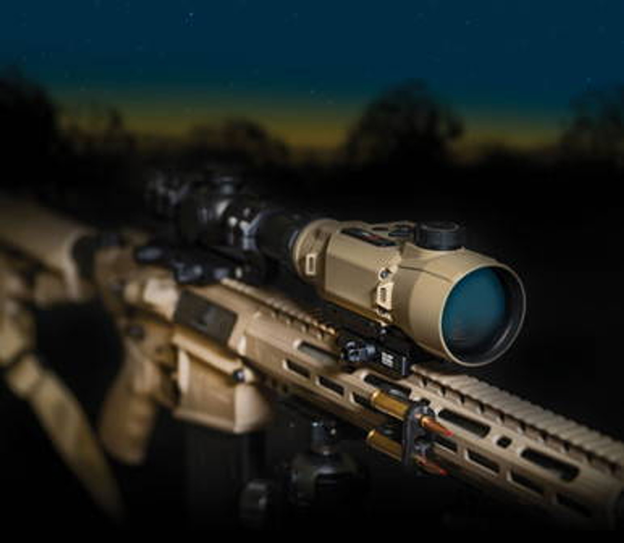
As you can see, the clarity of the image captured by a thermal scope is not solely the product of the sensor resolution, but is a combination of different ratings, of which the three major ones are captured here.
If you’re interested in any of the InfiRay thermal scopes mentioned here or would like to learn more about how to interpret the ratings of other thermal scopes, get in touch with Dark Night Outdoors directly at 309-781-8421 and we will help you find an optic that meets your needs.
