
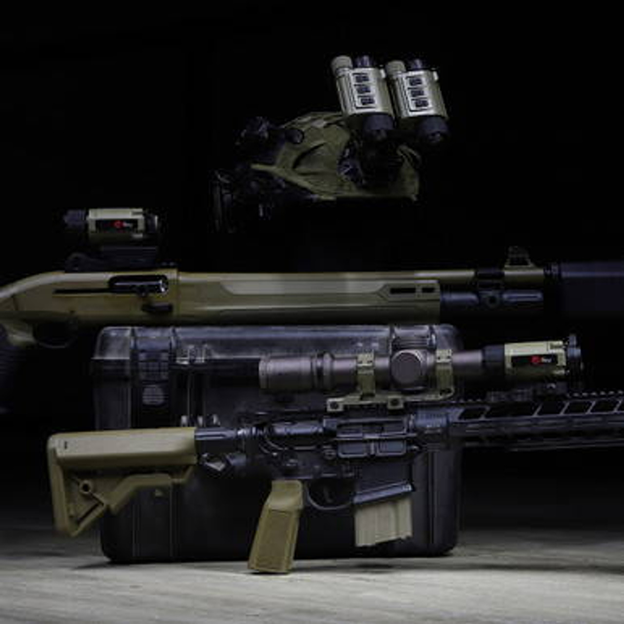
The clarity of the image produced by a thermal rifle scope is the product of many factors, not just one. Environment factors, such as thermal gradient between potential targets, as well as humidity levels, play a role here. So do the specifications of the thermal scope itself, such as the sensor resolution, NETD rating, and pixel pitch.
The latter metric is one that is a primary determinant of how fast the image processes, and how clearly the image display will ultimately be. Now, with the release of the InfiRay Hybrid Compact HCH50R, the market now has its first ever commercially available thermal scope with a pixel pitch of 10μm.
This has brought pixel pitch as a thermal optic specification into much sharper focus, as the nearest competing model has a pixel pitch of 12μm, and many others are as high as 17μm. However, the 10μm sensor of the HCH50R blows the performance of these others out of the water. Here’s what you need to know.
Better Sensitivity, Better Image Quality, Higher Speed
Pixel pitch, broadly, is the distance between the center of two adjacent pixels on a sensor. It is measured in μm, or micrometers, and the smaller the pitch, the more pixels will fit in a given space.
Most commercially available thermal rifle scopes from common brands like Nocpix and iRay USA have thermal sensors with either a 17μm or a 12μm pixel pitch. While those with 17μm sensors are more affordable, they cannot produce display images of the same resolution and overall quality as competing scopes with a lower pixel pitch.
The introduction of the InfiRay Hybrid Compact HCH50R, with a 10μm, means that there is now a thermal rifle scope on the market that inherently yields higher resolution images, regardless of conditions.
That being said, it is also the case that the lower pixel pitch of the new HCH50R is also superior in a wide range of adverse conditions, such as hot, muggy, high-humidity weather. It will perform better in these conditions than scopes with a higher pixel pitch, making it better for hot nocturnal hunts - such as for hogs.
It’s also not just that the higher resolution produces a clearer, sharper image almost regardless of conditions - it’s that the lower pixel pitch also enables the preservation of image quality even when using the digital zoom feature, which often yields a lower resolution image.
Another critical element of the smaller pixel pitch is that it makes the scope not just faster, but incredibly faster. In fact, the HCH50R with its 10μm sensor is 10 times faster, literally, than an alternative thermal rifle scope with a 12μm pixel pitch.
This phenomenon is referred to as latency and it describes the slight delay that occurs during image processing; a 12μm sensor might have a latency of around 150ms, whereas a scope with a 10μm might have a latency of about 15ms. It’s an entire order of magnitude.
The lower latency means there is less lag, which results in a smoother image, but it also means that you won’t need to lead your target by as much to connect, as might be the case with fast moving targets like predators.
Another generally advantageous note about thermal rifle scopes equipped with sensors with smaller pixel sizes is that they can be made comparatively smaller since the sensor can necessarily be more compact. This can potentially incur weight savings and yield a more compact thermal scope profile.
Since we’re on the topic of sensor resolution as a product of pixel pitch, it is also important to recognize that the clarity of a thermal image is also a product of the sensitivity of the sensor to thermal gradient, and not just of how many pixels the sensor contains.
This thermal sensitivity is called NETD rating, and it communicates a sense of how effectively the sensor can detect differences in temperature. A lower NETD rating will yield a sensor that is better able to detect fine thermal signatures. Not only will it produce a higher clarity display image, like a lower pixel pitch, it will also perform better in hot and humid conditions.
All in all, while resolution and NETD rating are important metrics that will determine the overall performance of a thermal scope, it is important not to lose sight of pixel pitch, as it also is involved in the ultimate quality of the image on the display.
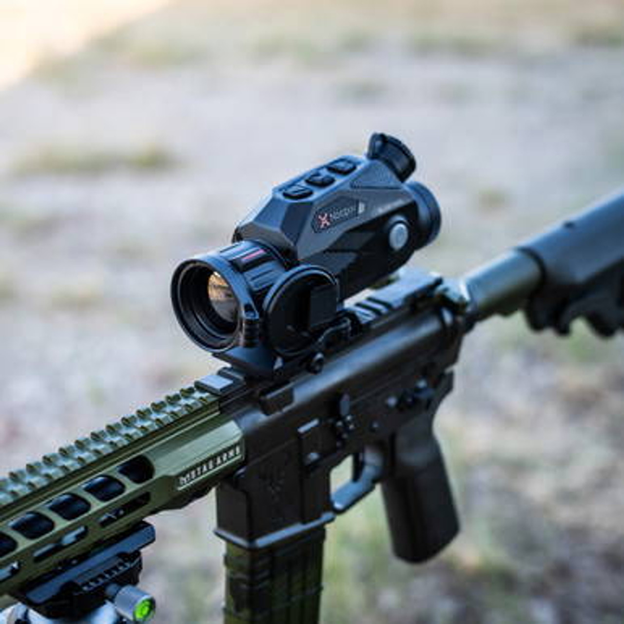
Explore Thermal Rifle Scopes at Dark Night Outdoors
Not sure which thermal rifle scope is best for you? Get in touch with us at 309-781-8421, let us know what you shoot, what you hunt, where you hunt, and what you’re looking for in a thermal optic. We’ll come up with a few recommendations so you can invest in the best thermal scope given your intended application the first time around!
