

Your night vision isn’t just helpful in the field during low-light hours (and in complete or near-complete darkness). Your ability to see is a matter of safety in addition to being able to competently execute a shot and then recover your prey.
Unfortunately, exposure even to dim lights of a certain wavelength will reduce the ability of your eyes to see well in darkness, but there are things you can do all the same to preserve your night vision.
Here’s your primer.
Night Blindness: How to Prevent It
Night blindness occurs primarily after your eyes have gradually adjusted to the darkness and then become suddenly exposed to a bright light.
It takes about 30 minutes or so for your eyes to fully adjust to darkness; however, your night vision can be very quickly reduced to exposure to certain wavelengths of light.
For instance, white and blue lights will counteract your night vision by photobleaching a protein in your eye called rhodopsin, which affects the visual transduction pathway.
Without getting too lost in the weeds of how that all works, suffice is to say that white and blue light, specifically, will cause you to go “night blind.”
Knowing this, here are a few tips for you to follow so you can help prevent night blindness.
Choose a Thermal Monocular Over Thermal Binoculars
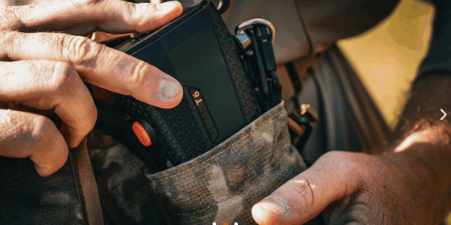
The display of your thermal scope, or in this case, monocular or binoculars, can have a pointed effect on your night vision.
To put it bluntly, the irony is that despite the fact that these optics enable you to detect thermal signatures in complete darkness, the LED displays can also cause you to go night blind.
One quick way to counteract this is to be judicious in your choice of thermal optics. If you use an optic for scanning or scouting, consider a thermal monocular instead of a pair of thermal binoculars.
Even though some hunters appreciate the form factor, controls and ergonomics of thermal binoculars better, the fact that the display projects light into both eyes can cause you to go night blind in a second.
A thermal monocular, which only allows you to view the display with one eye at a time, will at the very least help prevent you from going night blind in both eyes at once.
Choose an Appropriate Color Palette When Using a Thermal Optic
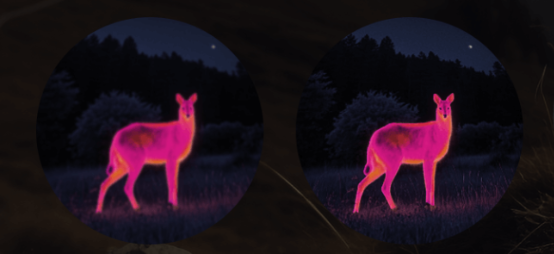
Many thermal optics, including thermal scopes in addition to monoculars and binoculars, are configurable with several different display color palettes.
If you can, set the color palette of the display to viridian, crimson, or Violet palette. Doing so will help preserve your night vision because red and green light is not as damaging to your night vision as other wavelengths of light.
View Thermal Optics with Only One Eye at a Time
The nature of some thermal optics is such that you can only use one eye at a time, such as thermal scopes and monoculars.
However, if you have a pair of thermal binoculars, and are concerned about a potential loss of night vision, then use only one eye at a time. This will limit your light exposure and help keep your night vision sharper.
Use a Red Light When Outside
There are times when you will need to use light outside so you can see what you’re doing. Getting to your hunt location, tracking game after a shot, or just looking around through your pack all will require at least a little ambient light. There’s no way around that.
While you can’t completely eliminate light exposure, you can somewhat control what color and therefore wavelength of light you use. There are red lights you can buy specifically for use in the field at night that will do less harm to your night vision than white or other cooler-temperature lights.
Get a few of these red lights and keep them in your pack; when you need a light, use one of these at night instead of a white or even a yellow light to help ensure that your night vision is less adversely affected.
Of course, the best advice is to keep in the dark as much as possible, but when you do need to use a light, use a red one.
Keep One Eye Closed When Exposed to Light
If you need to look at your phone, or go back to the truck for any reason, you’re going to be exposed to light that will not be sympathetic to your night vision.
One quick trick we have for you that will help preserve your night vision is that, when you are exposed to those (relatively) bright lights, keep one eye shut.
Doing so will help ensure that, even if you lose your night vision in one eye for a few minutes, you won’t suffer complete night blindness in both eyes.
Shut Your Eyes for 10 Seconds to Recover Your Night Vision
Our last bit of advice is that, if you are exposed to bright (or relatively bright) lights while you are in the field at night, one thing you can do is shut your eyes tight for at least 10 seconds to help accelerate your night vision recovery.
Granted, it is going to take a few minutes at least. As stated, it usually takes about 30 minutes or so for your eyes to fully adapt to the dark, but anything you can do to help it along can make a little difference.
Explore Thermal Optics Here
Hopefully you found these tips and suggestions for preserving your night vision to be helpful. If you’re here because you’re in the market for a new thermal optic such as a scope, or a monocular or binoculars for scouting and tracking, we represent the best brands in thermal optics.
Get in touch with Dark Night Outdoors directly if you have questions or want personalized recommendations; you can call us at 309-781-8421, and we are happy to help.
