
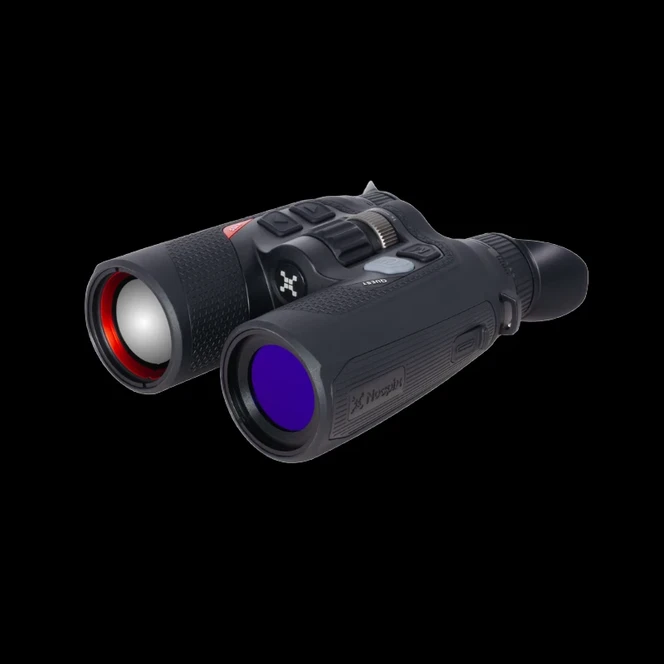
Night blindness, as it pertains to night hunting, refers to the temporary blindness experienced after being exposed to a bright light, or the blindness that occurs after you look through the eyepiece of a thermal scope, and then look away.
Depending on a few factors, it could be several minutes (or longer) before you get your visual acuity back. It takes some time for your eyes to adjust to the dark, and there’s more than one factor that contributes to the manifestation of night blindness in the first place; it’s not all about how bright the display of your thermal optic is. This guide will take a closer look into this phenomenon and what you can do about it.
What Causes Night Blindness?
First, let us be clear that we’re talking about night blindness as the temporary condition experienced in the field at night, not the medical condition that causes prolonged inability to see well under low light conditions.
For our intents and purposes, night blindness is caused primarily by two things: the intensity of light to which your eyes are exposed, and the color of the light, determined by its wavelength. The first aspect is easiest to understand so we will start there.
When your eyes are exposed to light, your pupil’s diameter adjusts in response; if the light is very bright, your pupil will contract, getting smaller, letting in less light, because less will be needed to form the appropriate image on your eye’s retina. This is why in bright sunlight your pupils appear very small.
In low light conditions, your pupils dilate, or get wider, to let in as much light as possible so that you can still see, even when it’s dark. In very dark conditions, your pupils will be as wide as possible to accommodate for the little light available.
Now, when you look through the eyepiece of a thermal scope, or through thermal monoculars, the light from the display is necessarily going to cause your pupil to contract. The issue here is when you look away from the display, it takes a couple seconds for your pupil to dilate so that you can see in the dark again.
This is one aspect of night blindness as far as we are concerned, but there are two silver linings. One is that it usually only takes a few minutes for your pupil to readjust to the dark, and many thermal binoculars, monoculars, and scopes have brightness settings that you can turn down to help counteract this issue.
The other aspect of night blindness is a little more obscure. In our eyes, there are proteins called opsins that are necessary for the visual transduction pathway (the process by which your eyes send signals to your brain that become the experience of sight) to occur.
To keep things as simple as possible, these opsins are all sensitive to different wavelengths of light, and all of them play a role in producing the sensation. One, called rhodopsin, is particularly sensitive to red light, and is critical to visual acuity in low light conditions.
Unfortunately, rhodopsin is extremely volatile in the presence of shorter wavelengths of light, such as daylight and blue light. When exposed to these, rhodopsin “photobleaches” which basically means it loses its form and cannot function. It can take 30 minutes or more for it to regenerate after it has been exposed to short wavelengths of light.
This means that, if you’re in the dark, and look at a thermal optic that has a mostly blue display, you can lose your night vision for a half hour or more, even if the brightness is turned way down.
With that being said, there are things you can do to combat these two issues.
A Monocular As a Potential Solution to the Problems Caused by Thermal Binoculars
Some people are more sensitive to the night blindness as described than others are. One thing you can do about it is use a thermal optic for scanning and scouting which only has one display rather than two. For instance, use a handheld monocular instead of thermal binoculars which will blind you in both eyes.
What Else You Can Do to Combat This Issue
In addition to swapping your thermal binoculars for a monocular, you can also adjust the setting on your optics, whatever they are. Set them to the lowest possible brightness, and while they will still impact your night vision, they won’t harm it as much.
Also, many thermal optics are equipped with multiple color palettes, such as white hot, black, Red Hot, and Fusion. Some Higher end scopes will have Viridian, Crimson and Violet these color palettes are what is known as “No Thermal Eye” color palettes, and is the best for your night vision as these wavelengths are less harmful to the rhodopsin in your eyes.
Also, when using other lights in the woods for navigation, try using red or green lights instead of white or blue lights, and again, use the dimmest lights you can. Not only will this help preserve your night vision, it will help prevent spooking game.

Shop Thermal Binoculars and Other Optics Here
Hopefully you found these tips for preserving night vision helpful. If you’re here looking for your next (or first) pair of thermal binoculars, or a new thermal scope? Shop our collection and get in touch with Dark Night Outdoors at 309-781-8421 and we’ll be happy to help you find what will work best for you.
