
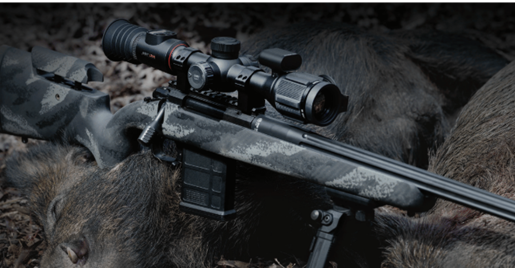
As in the realm of conventional glass optics, there are several types of thermal optics that offer distinct advantages and disadvantages to nocturnal hunters. This post should serve as a disambiguation while also offering the relative advantages and disadvantages of each category.
Thermal Monoculars
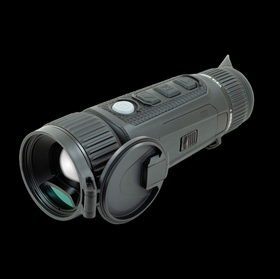
Thermal monoculars are handheld scanners that have one objective lens and one eyepiece or display; like a thermal scope. However, unlike a thermal scope, thermal monoculars are not intended to be mounted to a rifle’s receiver, and generally lack a reticle and recoil resistance. They also have a very different form factor since they are intended to be handheld.
Advantages
Some of the biggest advantages of thermal monoculars are:
- You only view a thermal monocular with one eye, which helps preserve your night vision in the other eye and prevent night blindness.
- Thermal monoculars are lighter, more compact, and tend to be more affordable than binoculars.
- If the specs are the same, thermal monoculars can do whatever other handheld thermal optics (including binoculars) can do.
- Monoculars are simpler and easier to use than thermal scopes.
- They offer a great deal of flexibility and versatility.
Disadvantages
All the same, thermal monoculars are not without their potential drawbacks:
- Some hunters don’t like viewing through one eye, as it can cause a headache.
- A dedicated monocular lacks a reticle and therefore cannot be used as a thermal scope for actually executing a shot.
Thermal Binoculars
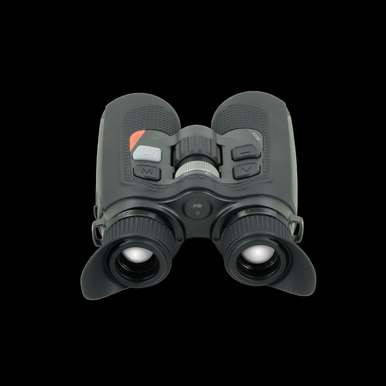
Thermal binoculars mimic the form factor, ergonomics and general controls of regulus glass optical binoculars, except they present a thermal image.
Advantages
Thermal binoculars offer some unique advantages over monoculars:
- Some users prefer them because they allow you to view a sight picture with two eyes, preventing headaches.
- They offer a more natural and ergonomic form factor for some than monoculars do, especially for those who prefer standard binoculars.
Disadvantages
Despite their advantages, there are some potential drawbacks to thermal binoculars:
- All else being equal, they are larger and heavier than thermal monoculars. They also tend to cost significantly more.
- They will increase the overall weight and footprint of your loadout.
- One common disadvantage they share with thermal monoculars is that they can only be used for scanning, scouting and tracking, and cannot be used to execute a shot.
Thermal Scopes
Thermal scopes are similar in function to thermal monoculars, except that they are designed to be mounted to a rifle and to serve as the firearm’s optic. Thermal scopes sport a reticle (or several reticle settings) and can be zeroed and used to actually execute a shot.
Advantages
Because of their expanded versatility, thermal rifle scopes offer several unique advantages:
- For all intents and purposes, a thermal scope, just like a monocular or binoculars, can be used for scanning, scouting and tracking; but since they are equipped with reticles, they can be zeroed and used to actually take a shot.
- Many thermal scopes also feature rangefinders and ballistic calculators that facilitate the execution of a shot.
- Many thermal scopes mimic the form factor and controls of conventional glass optics, streamlining the switchover from one to the other.
- Many thermal scopes can be used just as effectively during the day as in darkness, depending on what you are hunting.
Disadvantages
Despite their many advantages, there are several disadvantages of thermal scopes as well:
- For those that have no need for a dedicated thermal scope, the cost may not be worth it. Some might be better served by a handheld thermal optic.
- On a rifle that is used both during the day and at night, a thermal scope might be cumbersome, as every time it is removed and replaced, it will need to be re-zeroed.
- Holding all else equal, thermal rifle scopes tend to be more expensive than monoculars, and in some cases, binoculars.
Thermal Clip-On Optics
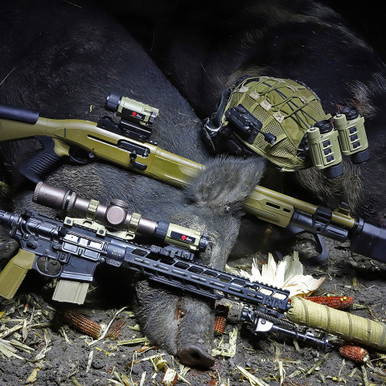
Thermal clip-on optics are specifically designed to be used as a clip-on; some may be clipped onto a helmet mount for hands-free viewing, others are intended to be clipped onto a rifle’s rail ahead of the main scope to serve as an augmentation for the scope, effectively converting it into a thermal optic.
Advantages
Because of the flexibility they offer, clip-on thermal optics offer some significant advantages compared with the other classes mentioned:
- Because they can be either attached to a rail or mount or used handheld, many thermal optics designed as clip-ons can be used as handheld scanners, akin to a thermal optic.
- Clip-on thermal optics offer the greatest flexibility in terms of usability of all thermal optics.
- With a clip-on thermal scope, you can convert your existing rifle scope to a thermal optic without needing to remove it from the rail. This enables you to use a glass optic during the day or in complete darkness without needing to remove it from the rail, or to re-zero it.
- Some clip-on thermal optics are relatively compact, lightweight and affordable.
Disadvantages
While clip-on thermal scopes offer numerous advantages, they are not without their drawbacks:
- Depending on the model, a clip-on optic may require an existing scope to be used as a thermal scope.
- Since they’re added onto your rifle, they increase the overall weight of your loadout and will also make your rifle more front-heavy.
- Some users may find that they are not as ergonomic when used as a handheld as a dedicated thermal monocular would be.
Make Sure You Compare Apples to Apples
Regardless of whether you determine a thermal monocular, scope, clip-on or a pair of binoculars is for you, make sure you are getting the specs equal before assessing value. Some specifications to compare include (but are not limited to):
- Sensor resolution
- Pixel pitch
- Frame rate
- NETD rating (lower is better)
- Display type and resolution
- Battery type and life
- Recoil rating
- IP rating
- Size and weight
- Display color settings
- Reticle settings
- Rangefinding capabilities
- Ballistic calculation capabilities
- Type of mounts
Being aware of the specifications and features of the thermal optic in question will help you compare utility, value and overall functionality.
Explore Thermal Optics Here; Call Us If You Need Recommendations
Hopefully you found this short guide helpful, but if you still have questions about what type of thermal optic is best for you, or you need help comparing a few different models, give Dark Night Outdoors a call at 309-781-8421 and we will be more than happy to help.
