


Free shipping on orders over $399* · $7.99 flat rate below $399*
Call today for current thermal scope specials and the latest pricing
Returns, Shipping & Preorders
Login / Sign Up

 Free shipping on orders over $399*
- No sales tax outside Illinois
 No card fees and 2% off when you pay by e-check
 Hunters on the phone to help you choose



Overview
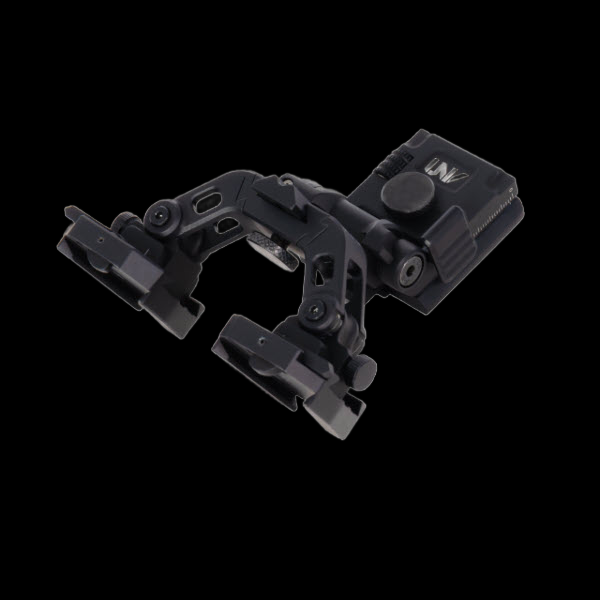
UNV Ultimate Helmet Mount

UNV Ultimate Helmet Mount
Modular Dual-Optic Bridge System
The UNV Ultimate Helmet Mount is a modular dual-optic bridge system designed to give users precise control, repeatable alignment, and maximum flexibility when running night vision or thermal optics on a helmet platform.
Built for stability and adaptability, the system allows independent adjustment of each optic while maintaining a balanced, low-profile configuration suitable for extended use.
Designed with real-world operation in mind, the UNV Ultimate Helmet Mount provides tool-free adjustment for vertical, tilt, lateral, and fore-aft positioning. This allows users to fine-tune optic placement for proper alignment, interpupillary distance, and eye relief without removing the system from the helmet.
Indexing marks and locking mechanisms ensure adjustments remain secure and repeatable during movement.
The bridge design supports rapid transitions between stowed and deployed positions and allows each optic to articulate independently. Whether running dual monoculars, thermal and night vision combinations, or a single optic configuration, the UNV Ultimate Helmet Mount offers a stable and configurable solution built to adapt to different mission requirements.
- Modular dual-optic bridge system for helmet-mounted use
- Independent adjustment for each optic, including tilt, vertical, lateral, and fore-aft positioning
- Tool-free controls with locking mechanisms for secure, repeatable setup
- Adjustable interpupillary distance for proper eye alignment
- Individual eye relief adjustment for optimized comfort
- Smooth articulation for stow and deploy transitions
- Compatible with a wide range of night vision and thermal optics
- Durable construction built for demanding field conditions
Specs
- Brand
- UNV
- SKU:
- UNV-UHM01
Frequently Asked Questions
Is thermal better than night vision on a helmet mount?
Each does a different job, which is why a dual-optic bridge like this one is popular. Thermal picks out warm animals in brush or darkness, while night vision shows terrain and obstacles more naturally for walking. With the UNV Ultimate mount you can run one of each side by side and adjust them separately.
How do I mount night vision to a helmet with the UNV Ultimate?
The mount attaches to the front of your helmet, and each monocular connects to the bridge. From there you set tilt, height, side-to-side position and fore-aft distance for each optic, plus eye spacing and eye relief, all without tools. Lock it down, and the indexing marks let you return to the same setup every time.
What should I look for in a night vision helmet mount?
Look for separate adjustment on each optic, locks that hold under rough walking, and a smooth flip between stowed and in front of your eye. The UNV Ultimate checks those boxes, with tool-free controls and indexing marks so your settings come back the same. It takes two night vision units, a thermal beside night vision, or a single optic.
Other UNV models in
